
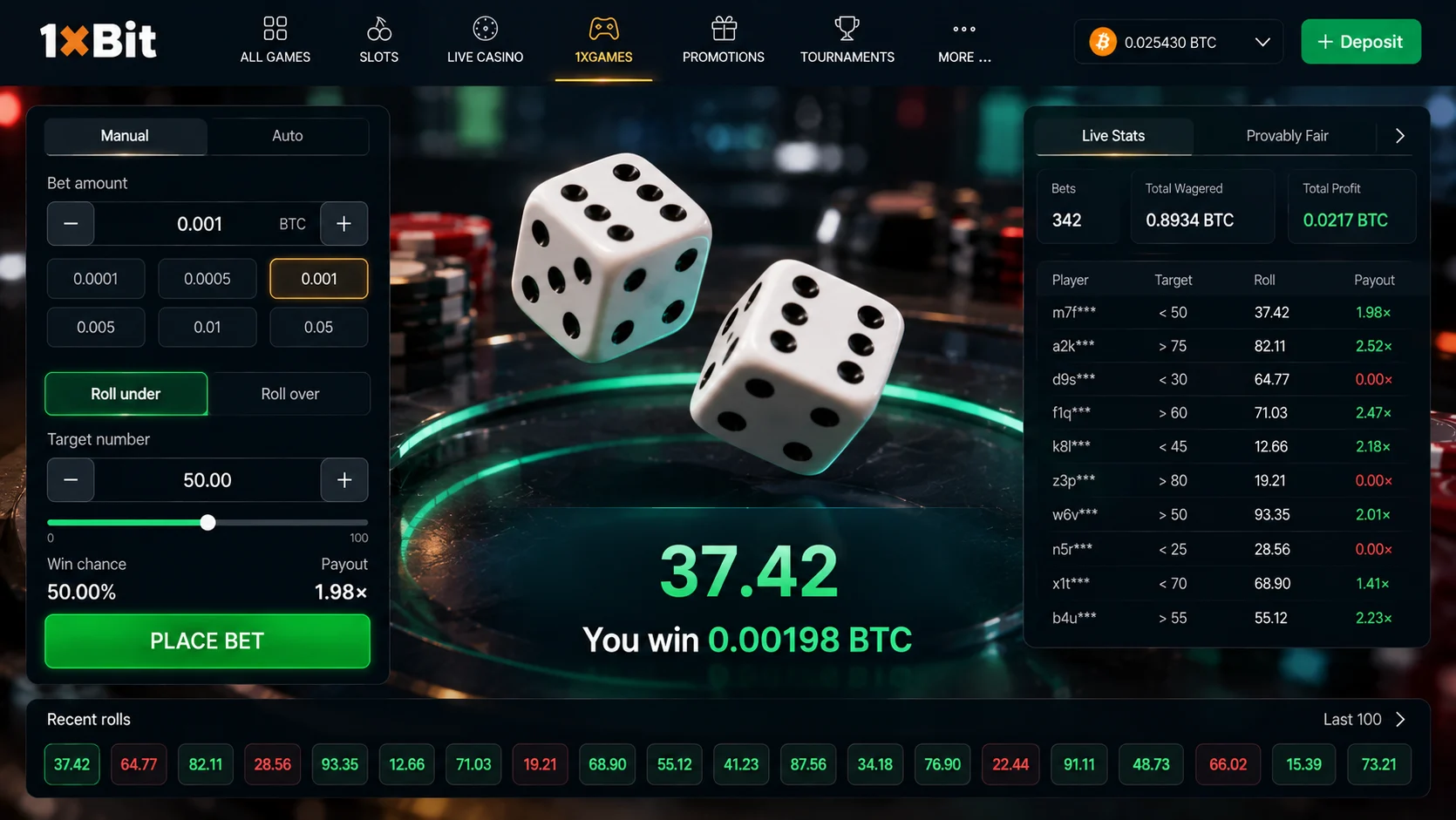
Unlike a conventional slot, Dice doesn't require matching symbols or waiting for bonus rounds. Its main feature is the relationship between win probability and payout multiplier: choosing a more likely outcome generally means a smaller potential return.
Dice appears in the 1xBit-related keyword data, although the exact rules, multipliers and verification features of the current 1xBit game have not been independently confirmed.
Dice Game Overview
| Feature | Details |
|---|---|
| Game | Dice |
| Category | Instant casino game |
| Main mechanic | Predict a random numerical result |
| Common bet types | Roll Under / Roll Over |
| Player controls | Stake and target, where available |
| Payout | Based on the selected odds |
| Round duration | Typically a few seconds |
| Provably fair | Depends on the game implementation |
| Cryptocurrency | Subject to supported account currencies |
- Details
- Dice
- Details
- Instant casino game
- Details
- Predict a random numerical result
- Details
- Roll Under / Roll Over
- Details
- Stake and target, where available
- Details
- Based on the selected odds
- Details
- Typically a few seconds
- Details
- Depends on the game implementation
- Details
- Subject to supported account currencies
The word Dice is used by several casino providers, and their games don't necessarily follow identical rules. This guide explains the common crypto dice format; the actual 1xBit game panel remains the reference for its specific settings.
How to Play Crypto Dice
Most crypto dice games use a numerical scale and let the player choose which side of a target the result should fall on.
A typical round works as follows:
Open Dice in the casino games catalogue.
Enter the amount to stake.
Choose Roll Under or Roll Over, if both options are available.
Adjust the target number or desired win probability.
Check the payout multiplier shown on screen.
Confirm the bet and view the generated result.
If the result falls within the selected winning range, the bet pays at the displayed multiplier. Otherwise, the stake is lost.
Roll Under vs Roll Over
In a Roll Under bet, the winning result must be below the selected threshold. In a Roll Over bet, it must be above the threshold.
For example, on a hypothetical 0–100 scale, a Roll Under target of 40 would cover approximately 40% of the range. A Roll Over target of 80 would cover approximately 20%.
The precise comparison operators and treatment of boundary values depend on the game's numerical system. A game using integers from 0 to 99 may calculate its outcomes differently from one using decimal values.
Dice Probability and Payout Multipliers
The defining relationship in Dice is straightforward: a lower winning probability usually comes with a higher payout multiplier.
<box></box>
| Illustrative win chance | Fair multiplier before house edge |
|---|---|
| 10% | x10.00 |
| 20% | x5.00 |
| 40% | x2.50 |
| 50% | x2.00 |
| 75% | x1.33 |
| 90% | x1.11 |
- Fair multiplier before house edge
- x10.00
- Fair multiplier before house edge
- x5.00
- Fair multiplier before house edge
- x2.50
- Fair multiplier before house edge
- x2.00
- Fair multiplier before house edge
- x1.33
- Fair multiplier before house edge
- x1.11
These are mathematical examples, not verified 1xBit payout multipliers.
The fair multiplier is calculated as:
Fair multiplier = 100 ÷ Win probability (%)
A casino typically applies a house edge, so the multiplier offered in a real game will generally be lower than the fair value.
Example: A 40% Win Chance
Suppose a player selects a 40% chance of winning and stakes 100 units.
Without a house edge, the fair total payout would be 250 units. If the game instead offers x2.45, the winning return would be 245 units, including the original stake.
That difference reflects the payout structure. The exact house edge cannot be established without knowing the real game's probability and multiplier settings.
What Is the House Edge in Dice?
The house edge is the mathematical advantage built into the payout system.
For a game with a 40% win probability and a x2.45 total payout multiplier:
Theoretical RTP = 0.40 × 2.45 × 100 = 98%
That corresponds to a theoretical house edge of 2%.
This is an illustrative calculation, not an RTP claim for Dice at 1xBit.
The formula is useful because it allows players to compare the probability displayed by a game with the multiplier actually offered. If both values are known, the theoretical return can be calculated directly.
Is Dice Provably Fair?
Many crypto-native dice games use provably fair systems. These allow a completed result to be checked using cryptographic data, often involving a server seed, client seed and nonce.
The typical verification process involves:
A cryptographic commitment to the server seed before play.
A client seed used as part of result generation.
A nonce identifying the round.
A revealed server seed and verification method after the relevant seed cycle.
The exact algorithm varies by developer. A game shouldn't be described as provably fair unless its interface provides the necessary verification information.
Provably fair verification helps establish that a result was generated according to the stated process. It doesn't predict the next roll or eliminate the house edge.
Dice Betting Strategies: What Actually Changes?
Players sometimes adjust the target after a losing round or increase their stake to recover previous losses.
Neither action changes the underlying probability of an independent random result.
A 20% winning chance remains 20% on the next round, regardless of how many previous bets have lost. Raising the stake increases the potential payout, but also increases the amount that can be lost.
Some dice interfaces offer automated betting options. If available, those controls can repeat bets or change stakes according to predefined settings. They do not turn a negative-expectation game into a profitable one.
Dice vs Under and Over Seven
These games share a name-related theme but have different betting mechanics.
| Feature | Dice | Under and Over Seven |
|---|---|---|
| Main prediction | Numerical result above or below a target | Sum of two dice relative to 7 |
| Adjustable target | Common in crypto dice | Fixed threshold of 7 |
| Winning probability | Often adjustable | Fixed by chosen outcome |
| Possible results | Depends on numerical scale | Totals from 2 to 12 |
| Payout multiplier | Usually changes with probability | Fixed for each bet type |
- Dice
- Numerical result above or below a target
- Under and Over Seven
- Sum of two dice relative to 7
- Dice
- Common in crypto dice
- Under and Over Seven
- Fixed threshold of 7
- Dice
- Often adjustable
- Under and Over Seven
- Fixed by chosen outcome
- Dice
- Depends on numerical scale
- Under and Over Seven
- Totals from 2 to 12
- Dice
- Usually changes with probability
- Under and Over Seven
- Fixed for each bet type
In Under and Over Seven, players choose between Under 7, Exactly 7 and Over 7. The documented version uses two six-sided dice.
Dice, by contrast, commonly uses a configurable numerical threshold and may not simulate physical dice at all.
Playing Dice with Bitcoin at 1xBit
1xBit advertises support for Bitcoin, Ethereum, USDT, Litecoin and other cryptocurrencies.
Cryptocurrency is used to fund the account. It doesn't determine the random outcome of a Dice round or improve the selected probability.
Before playing, check the game's available stake limits, displayed multiplier and any currency conversion applied to the account balance.
For more on supported coins, see our 1xBit Bitcoin Casino Guide.
Dice on Mobile and Demo Play
The short-round format of Dice works well with mobile interfaces, particularly when the game provides simple stake and target controls.
However, mobile compatibility and demo availability depend on the exact game implementation offered by the casino.
If a free-play version is available, it can help demonstrate how changing the target affects the multiplier. Demo results shouldn't be treated as evidence of future real-money outcomes.
Frequently Asked Questions
What is Dice at 1xBit?
Dice is a casino game name found in 1xBit-related searches. Crypto dice games commonly involve predicting whether a random numerical result will fall above or below a selected threshold. The exact current 1xBit implementation requires verification.
Is Dice a crypto slot?
No. Dice is an instant probability-based game rather than a reel-based slot machine.
How do Roll Under and Roll Over work?
Roll Under wins when the generated number is below the selected threshold. Roll Over wins when it is above the threshold, subject to the game's exact boundary rules.
Can I change my winning probability?
Many crypto dice games let players adjust the target number, which changes the probability and payout multiplier. Availability of this control depends on the specific version.
What is the RTP of Dice at 1xBit?
A verified RTP for the current 1xBit Dice game has not been established. It can be calculated from the game's displayed probability and total payout multiplier when those figures are available.
Is Dice provably fair?
Some crypto dice games are provably fair, but the feature must be confirmed for the specific game. Look for seed information and a result-verification tool.
Can I play Dice using Bitcoin?
1xBit supports Bitcoin as an account funding currency. Whether a particular Dice game is available depends on the casino catalogue.
Does increasing my stake improve the chance of winning?
No. The stake affects the amount won or lost, not the probability of the generated result.
Explore more titles in the 1xBit Crypto Games catalogue or return to the 1xBit Crypto Casino homepage.